MARINE PRECAST CONCRETE
Precast Marine Coping Beam Supplier in the UAE
CPGBM/12 reference model for quay walls, seawalls, ports, marinas and waterfront structures
Jetons supplies precast marine coping beams for approved structural edge, capping and interface requirements. Product review can include geometry, reinforcement, embedded items, lifting, transport, offloading and installation coordination.
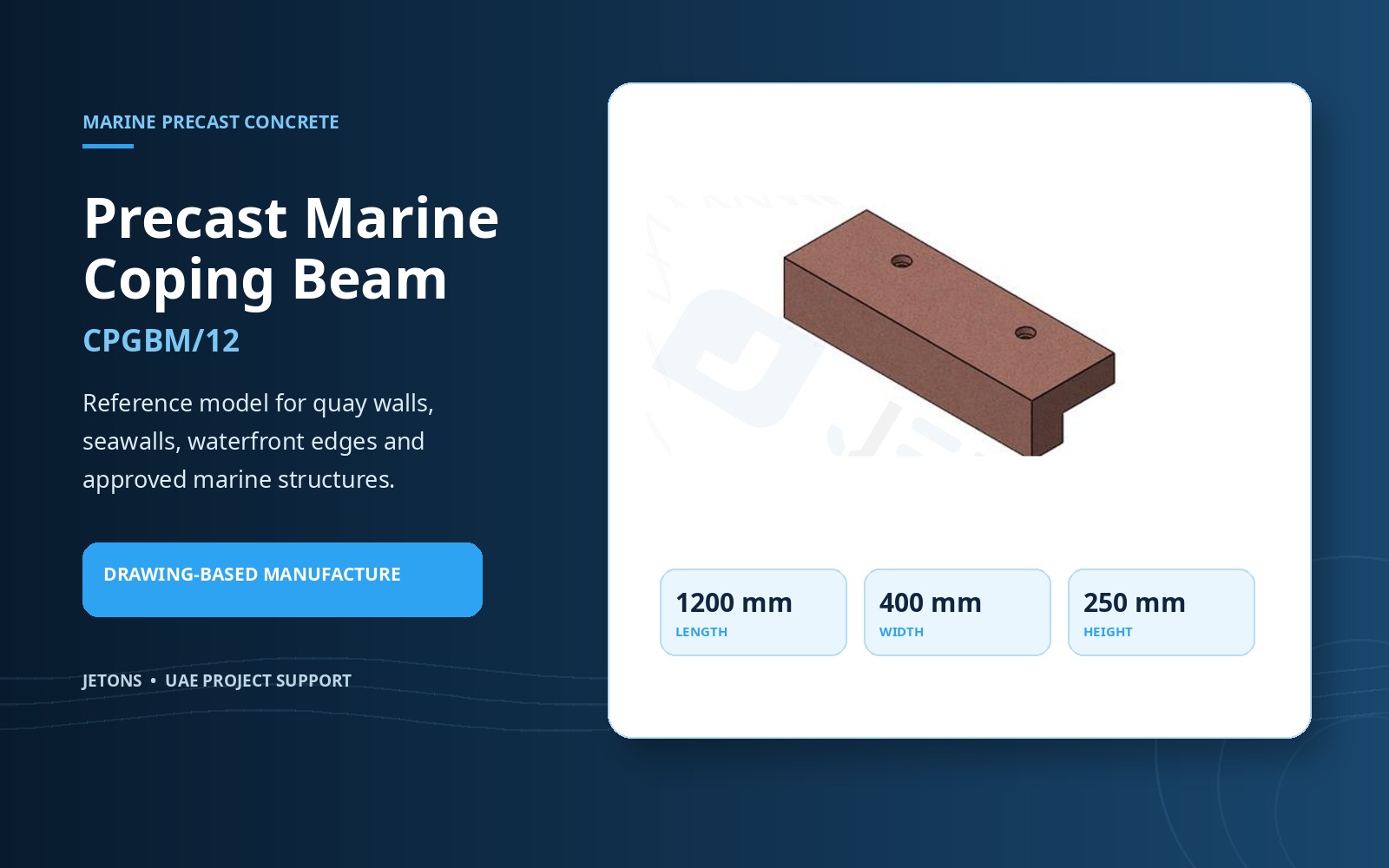
Reference Size
1200 × 400 × 250 mm
Product Code
CPGBM/12
Manufacturing Basis
Latest approved drawing and specification
Available Scope
Supply, UAE-wide delivery and installation support
COPING BEAM EXPLAINED
What Is a Precast Marine Coping Beam?
A coping beam—often called a capping beam in marine and retaining-wall drawings—forms a controlled concrete edge at the top of an approved structural system. It may complete the profile, connect adjoining work and provide coordinated locations for joints, reinforcement or embedded interfaces.
Definition for buyers and project teams
A precast marine coping beam is a reinforced-concrete beam manufactured in a controlled precast environment and placed at the upper edge of a quay wall, seawall, retaining wall, jetty, marina or waterfront structure when required by the approved design.
Depending on the project, the element may act as an edge beam, capping unit, finishing beam or interface element. Terminology varies between consultants and contractors, so the plan, section, structural notes, loads and connection details must be reviewed together.
Top-edge concrete element
Creates the approved top or exposed edge profile of the supporting marine or civil structure.
Project-specific structural role
May distribute, connect, finish or interface with other components only as shown by the designer.
Coordinated cast-in details
Openings, sleeves, plates, sockets, dowels, channels and inserts can be reviewed before production.
Planned handling and placement
Unit weight, lifting points, transport supports, crane access and installation sequence are checked in advance.
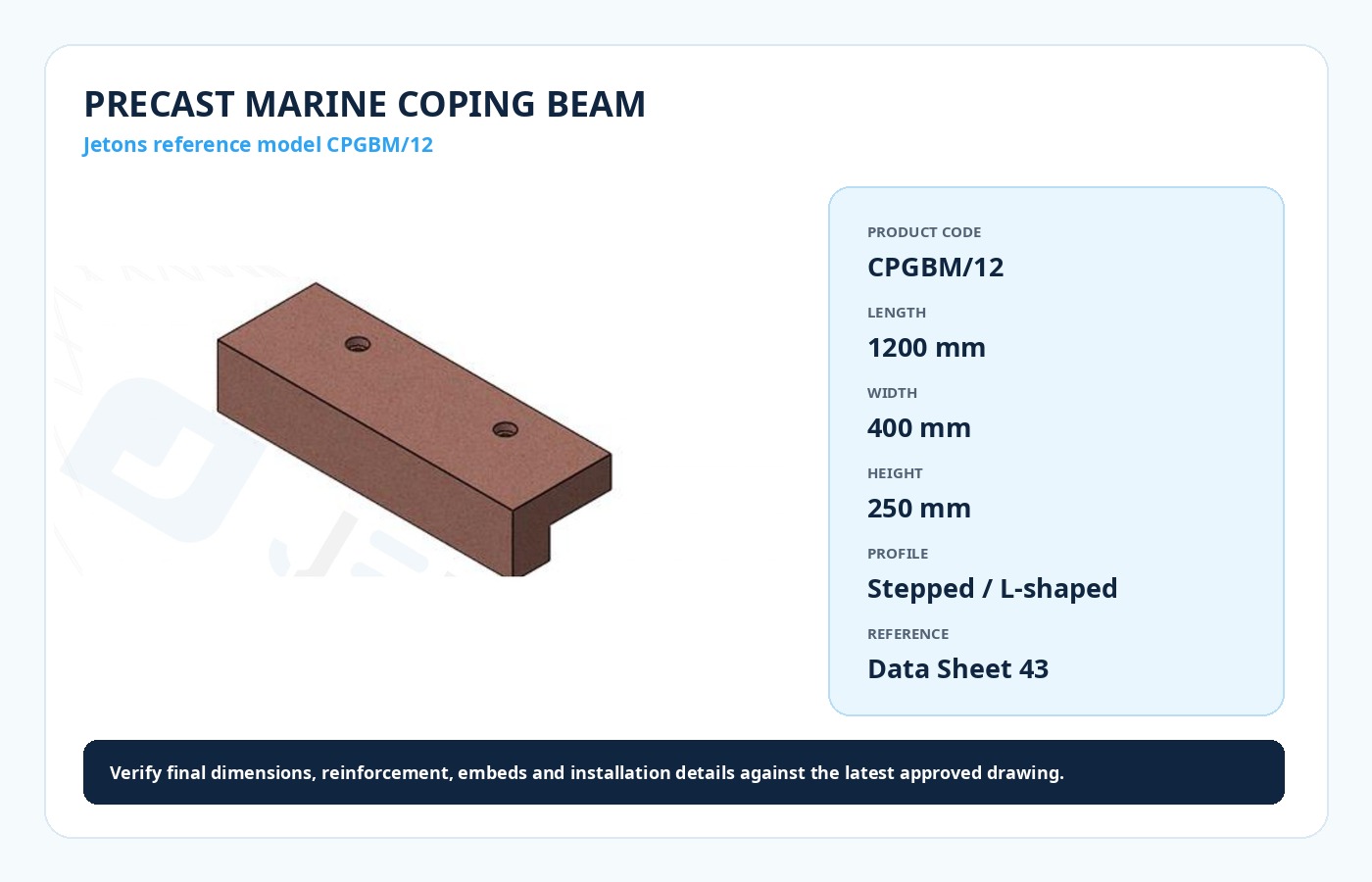
REFERENCE PRODUCT DATA
Jetons Coping Beam CPGBM/12
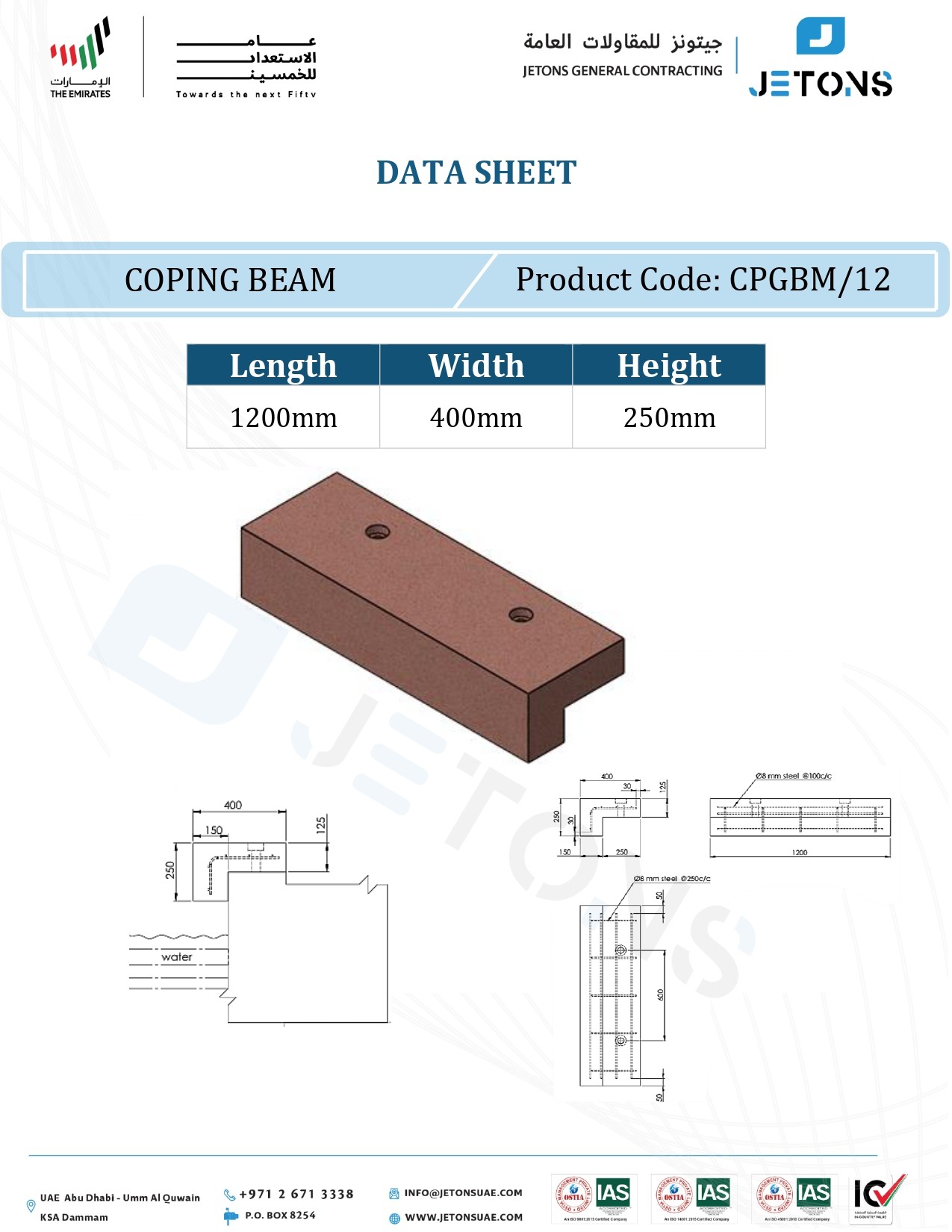
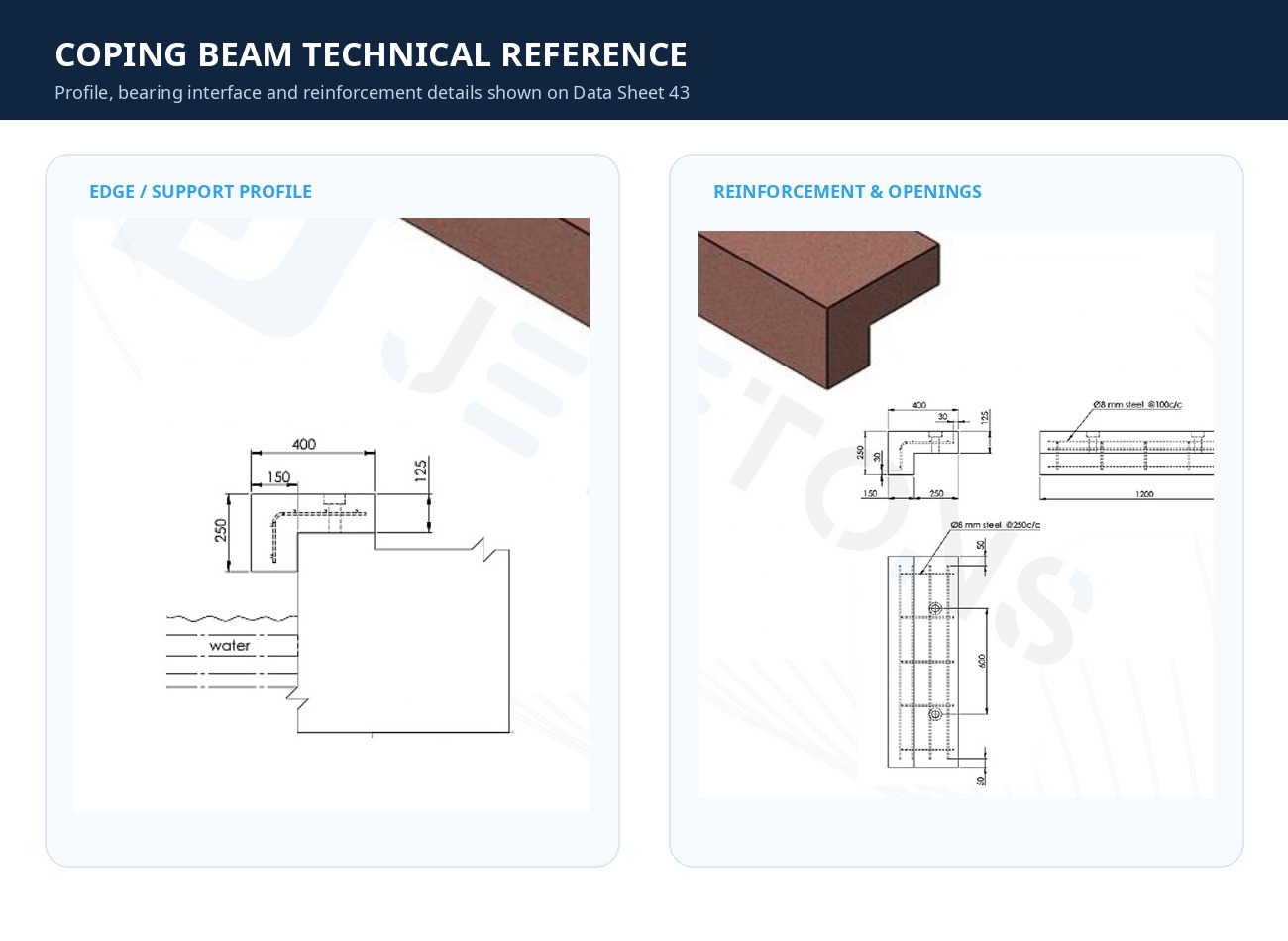
The current Jetons data sheet identifies a compact stepped or L-shaped precast coping beam. The readable reference values are provided below to help buyers compare the model before submitting the approved project details.
| Product name | Precast Marine Coping Beam |
| Product code | CPGBM/12 |
| Overall reference dimensions | 1200 mm length × 400 mm width × 250 mm height |
| Illustrated profile | Stepped / L-shaped edge profile as shown on Data Sheet 43 |
| Top openings | Two circular top openings are illustrated; confirm whether they are lifting, anchoring or project-interface points |
| Reinforcement shown | Ø8 mm steel at 100 mm c/c and Ø6 mm steel at 250 mm c/c are indicated on the reference drawing; latest approved reinforcement details govern |
| Concrete and durability | Not fixed by the web reference; confirm grade, exposure class, concrete cover, crack control, curing and project specification |
| Technical reference | Jetons Data Sheet 43 |
CONTROLLED INFORMATION
Use the Data Sheet as a Reference—Not the Final Design
The published sheet is useful for identifying the current Jetons reference product, overall dimensions and illustrated reinforcement arrangement. Final manufacturing information should be issued through the approved drawing and specification.
- Confirm plan, elevation and cross-section
- Confirm structural loads and support conditions
- Confirm reinforcement, cover and continuity details
- Confirm openings, inserts and embedded metalwork
- Confirm concrete durability and marine exposure requirements
- Confirm lifting points, unit weight and installation sequence
TYPICAL PROJECT APPLICATIONS
Where Precast Marine Coping Beams Are Used
Coping beams are selected as part of a complete marine or structural design. The examples below describe common project environments, not automatic approval for every location or load case.
Quay Walls & Harbour Edges
For approved top-edge, capping or interface details along quay walls and port structures.
Seawalls & Retaining Structures
For compatible coping arrangements on coastal retaining walls, sheet-pile walls or other approved wall systems.
Jetties, Marinas & Dock Edges
For project-specific edge beams on jetties, marina structures, docks and waterfront platforms.
Handrail & Fender Interface Zones
For sockets, plates, inserts or connection zones when their loads and details are included in the approved design.
Service & Utility Interfaces
For sleeves, drainage openings, conduits or cast-in components shown on coordinated structural and MEP drawings.
Custom Waterfront Civil Works
For water features, promenades and special edge details where a precast beam is technically suitable.
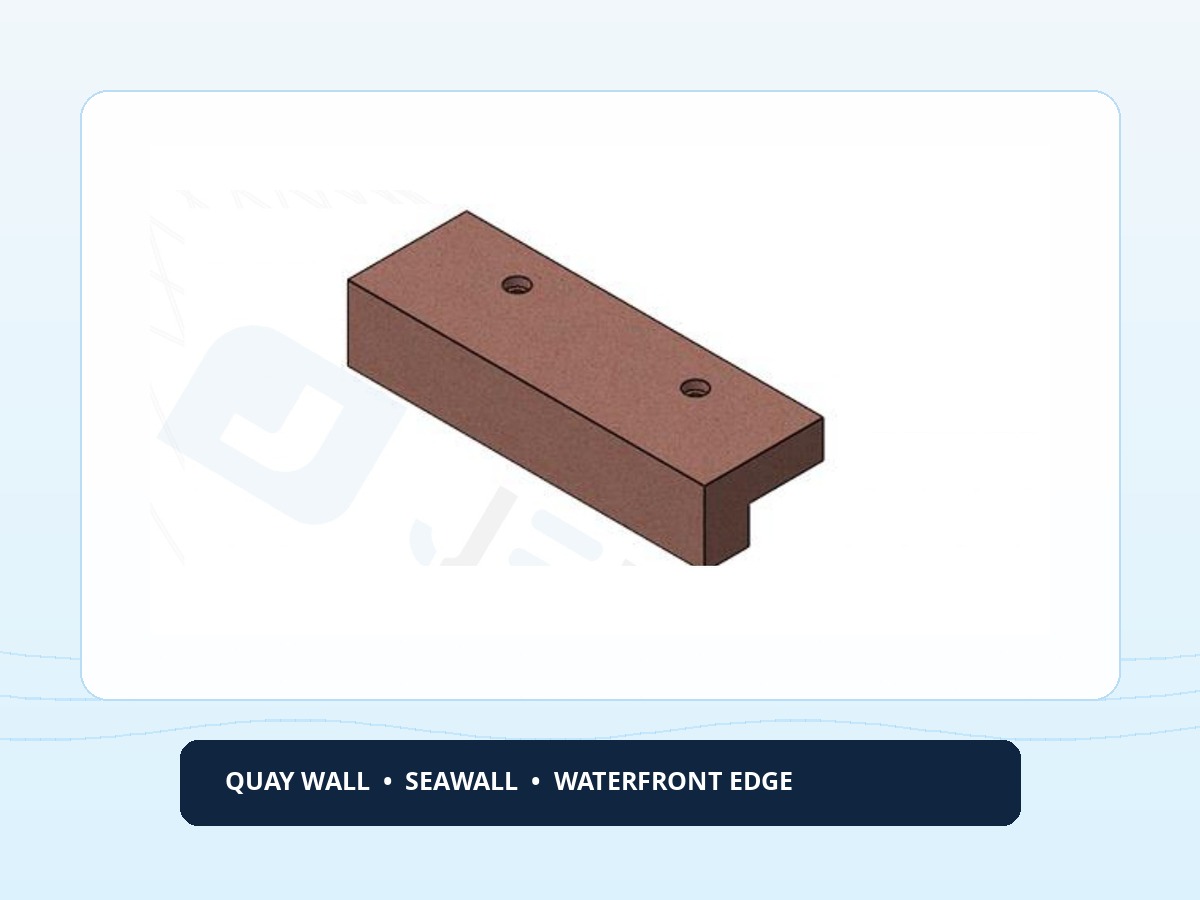
APPLICATION CHECK
Confirm What the Beam Must Actually Do
Some coping beams mainly complete the edge profile. Others may connect wall heads, support adjoining concrete, receive reinforcement continuity or carry project-specific fixtures. These functions require different design details.
- Identify the supporting wall or structure
- Confirm whether the beam is structural, architectural or both
- Identify any fender, handrail, bollard, ladder or service interface
- Confirm whether imposed, mooring, impact or maintenance loads apply
- Confirm joint spacing and adjoining in-situ concrete
- Confirm construction-stage and temporary-stability requirements
TERMINOLOGY & SELECTION
Coping Beam, Capping Beam or Edge Beam?
Search terms and project labels often overlap. The correct interpretation comes from the approved drawing and structural role rather than the wording used in an enquiry.
| Term | How it is commonly used | What must be confirmed |
|---|---|---|
| Marine coping beam | Top or exposed edge beam that forms a finished and coordinated waterfront interface. | Profile, support, loads, joints, embeds, exposure and installation. |
| Capping beam | Beam that caps or connects the heads of a wall, piles, sheet piles or retaining elements. | Structural continuity, anchorage, load transfer and connection to the supporting system. |
| Cap / edge beam | Broader terms used for beams at the top or perimeter of different structures. | Whether the requested element is actually the same geometry and function as the Jetons reference product. |
Geometry & Support
Confirm beam section, length, bearing, wall profile, levels, curves, corners, end details and tolerances.
Loads & Reinforcement
Confirm dead, imposed, impact, surcharge, mooring or fixture loads where applicable, plus reinforcement and continuity.
Connections & Embeds
Coordinate starter bars, dowels, couplers, plates, channels, sockets, sleeves, bolts and service openings.
Joints & Adjoining Work
Confirm joint width, grout, sealant, in-situ stitch concrete, waterstops and interface preparation.
Lifting & Transport
Confirm lifting anchors, unit weight, orientation, transport supports, route restrictions and crane reach.
Installation & Temporary Stability
Confirm sequence, bearings, shims, alignment, bracing, access, survey control and handover requirements.
MARINE DURABILITY REVIEW
Durability Requirements Must Match the Exposure
Marine coping beams can be exposed to chlorides, wetting and drying, spray, tidal action, abrasion, heat and construction damage. The approved specification should identify the exposure zone, design life and durability controls.
- Atmospheric, splash, tidal or submerged exposure
- Concrete grade, binder requirements and water-cement limits
- Reinforcement type, concrete cover and crack-control criteria
- Curing, permeability and surface-finish requirements
- Embedded-metal protection and compatible materials
- Coatings, sealants, joint materials and repair procedures
- Inspection, testing and documentation requirements
Exposure Zone
State whether the unit is above water, in splash or tidal exposure, or subject to direct wetting and salts.
Design Life & Crack Control
Confirm the specified service life, cover, crack-width limits and structural detailing.
Embedded Metal Protection
Confirm material grade, galvanizing, coating, isolation and corrosion protection for inserts and plates.
Quality Records
Confirm mix approvals, material certificates, inspections, test reports, dimensional checks and release documents.
UAE-WIDE PROJECT SUPPORT
Precast Coping Beam Supply Across the UAE
Jetons can review coping-beam supply, transport and installation requirements throughout the Emirates. Marine logistics should be planned around unit size, site access, port or security controls, lifting equipment and the project sequence.
Abu Dhabi & Al Dhafra
Coastal, island, industrial and remote projects may require early route review, gate passes, delivery windows, laydown areas and crane or barge coordination.
Dubai, Sharjah & Ajman
Urban waterfront and port projects can require timed deliveries, traffic planning, restricted access and closely sequenced lifting.
Ras Al Khaimah, Fujairah & Umm Al Quwain
Port, coastal and mountain-route conditions may affect transport, permits, ground access, unloading and marine placement planning.
Al Ain & Inland Water Projects
Inland yards, pools, water features and civil structures still require approved geometry, delivery access and lifting arrangements.
What should be checked before delivery?
Confirm final unit weight, truck and trailer arrangement, lifting points, crane or Hiab capacity, access width, turning space, ground-bearing condition, storage supports, permits, gate passes, delivery windows, tide or weather restrictions where relevant, and the installation sequence.
Scope clarity: Offloading and installation are included only when stated in the confirmed quotation and purchase order.
FROM DRAWING TO PLACEMENT
Manufacturing, Delivery and Installation Support
Clients can request precast supply only or coordinate a wider scope after the technical and logistical requirements are confirmed.
Technical Review
Review drawings, dimensions, reinforcement, interfaces, mould feasibility, quantities and missing information.
Precast Manufacturing
Prepare the mould and reinforcement, coordinate cast-in items, cast, cure, inspect and release units against the agreed documents.
Transport & Delivery
Plan vehicles, supports, routes, permits, delivery sequence, gate access and laydown requirements.
Lifting & Installation
Coordinate offloading, crane or Hiab access, placement, alignment, joints, temporary stability and installation records when included.
PRICE & QUOTATION GUIDE
What Affects Coping Beam Price in the UAE?
Direct answer: Coping-beam price depends on the approved geometry, reinforcement, concrete and durability requirements, quantity, mould work, embedded items, inspection, transport, lifting and installation scope. A dimension alone is not enough for a reliable quotation.
Size & Profile
Length, width, height, step profile, corners, curves, rebates and unit weight.
Reinforcement & Concrete
Bar quantity, couplers, concrete grade, cover, durability, special cementitious or exposure requirements.
Quantity & Moulding
New mould cost, repetition, production rate, programme, prototypes and mock-ups.
Embeds & Finish
Plates, sockets, sleeves, openings, lifting anchors, surface finish, coatings and repairs.
Inspection & Documentation
Approvals, ITPs, hold points, testing, third-party inspection and technical submittals.
Logistics & Installation
Delivery distance, route permits, unit handling, crane reach, access, placement, joints and supervision.
Technical Information
- Latest approved plan, section and reinforcement drawing
- Required coping-beam dimensions and profile
- Concrete, exposure, cover and durability specification
- Loads, support, joints and connection details
- Openings, plates, sockets, sleeves and other embeds
- Finish, coating, tolerances and testing requirements
Project & Logistics Information
- Project name and UAE location
- Required quantity and delivery schedule
- Drawing number, revision and approval status
- Truck access, permits and gate-pass requirements
- Offloading, crane or Hiab and installation scope
- Consultant inspection and document-submission requirements
Request an accurate coping-beam quotation
Send the controlled drawings and scope information together. Jetons can then review the standard CPGBM/12 reference or assess a project-specific coping-beam configuration.
COPING BEAM FAQ
Frequently Asked Questions
These answers help contractors, consultants and procurement teams understand the product. Final manufacture, approval and use must follow the latest controlled project information.
What is a precast marine coping beam?
A precast marine coping beam is a factory-cast reinforced-concrete unit used along the top or exposed edge of an approved quay wall, seawall, retaining structure, marina edge or other waterfront work. Its exact structural role must be confirmed from the project drawing.
What is the difference between a coping beam and a capping beam?
The terms often overlap. “Capping beam” commonly describes a beam that caps or connects wall or pile heads, while “coping beam” may describe the finished upper edge or interface beam. The approved drawing, loads and connection details define the actual function.
What are the Jetons coping-beam reference dimensions?
The current Jetons reference sheet for product code CPGBM/12 shows an overall length of 1200 mm, width of 400 mm and height of 250 mm. These are reference values and must be checked against the latest approved drawing.
Can Jetons manufacture custom coping-beam dimensions?
Project-specific lengths, profiles, reinforcement, openings and embedded items can be reviewed subject to approved technical information, mould feasibility, quantity, production programme and transport limitations.
Can a coping beam be used on a quay wall or seawall?
It may be used where the structural or marine designer specifies a compatible coping or capping element. Suitability depends on support conditions, loads, exposure, joints, connections and installation details.
Can handrail, fender, bollard or service interfaces be included?
Sockets, plates, sleeves, channels, openings and other cast-in items can be coordinated when fully detailed before production. The coping beam must not be assumed to carry fender, bollard, railing or service loads unless the approved design specifically requires and verifies them.
What concrete grade and reinforcement are used?
The concrete specification, durability class, cover and reinforcement must follow the approved project documents. The current web reference shows Ø8 mm bars at 100 mm centres and Ø6 mm bars at 250 mm centres, but the latest controlled drawing governs.
Does Jetons deliver and install coping beams across the UAE?
UAE-wide transport, offloading, lifting and installation support can be coordinated when included in the confirmed scope, subject to unit weights, access, permits, crane reach, delivery windows and programme.
What affects coping-beam price and lead time?
Key factors include dimensions, profile, reinforcement, concrete and durability requirements, mould work, quantity, embedded items, finish, testing, documentation, transport, lifting and installation scope.
What information is required for a coping-beam quotation?
Send the latest plan, section and reinforcement drawing, product dimensions, quantity, project location, concrete and exposure requirements, embedded items, delivery dates, site access and required offloading or installation scope.
RELATED PRODUCT ROUTES
Explore Marine and Custom Precast Options
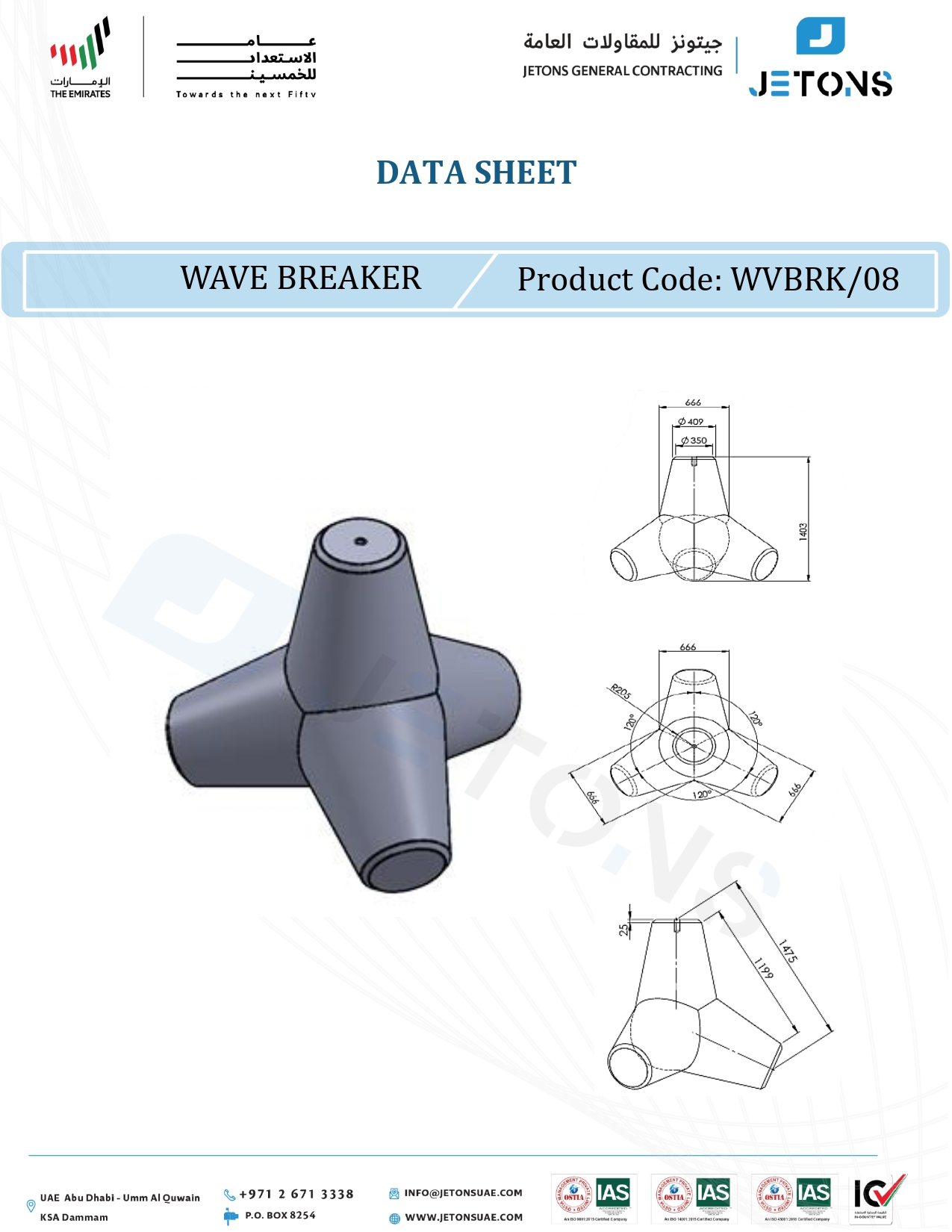
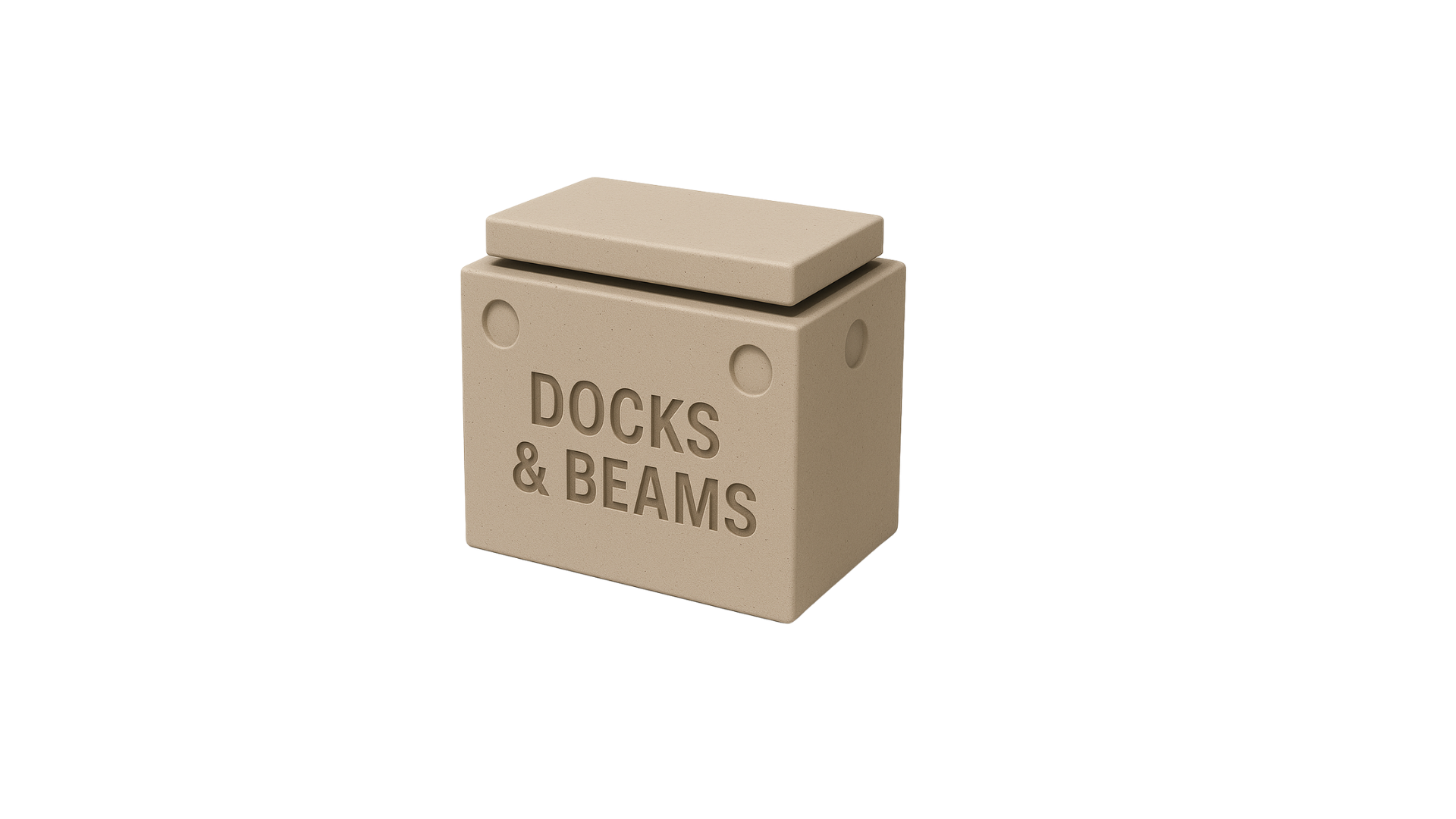
Use the marine category for the full range, compare the wave-breaker product, or send an approved drawing for a custom precast requirement.
START YOUR COPING-BEAM ENQUIRY
Need a Precast Marine Coping Beam for a UAE Project?
Send the latest drawing, required dimensions, reinforcement, quantity, project location, delivery programme and offloading or installation scope. Jetons will review whether the CPGBM/12 reference or a project-specific beam is appropriate.

DIVISIONS
Jetons General Contracting
Jetons General Trading
Beam Concrete Works
Jetons Transportation
QUICK LINKS
About Us
Projects
FAQ's
Careers
CONTACT US
📞 Phone
📮 P.O. Box
UAE Coverage
Abu Dhabi | Dubai | Sharjah | Ajman | RAK | Al Ain
Supply • Transportation • Installation • Traffic Management
Project Support Across UAE
CERTIFIED & TRUSTED
Certified to International Standards • Trusted by Clients • Committed to Quality
