COASTAL & MARINE PRECAST
Precast Concrete Wave Breaker Supplier in the UAE
WVBRK/08 wave-breaker unit for engineered breakwater, shoreline-protection and wave-attenuation systems
Jetons supplies and reviews precast concrete wave-breaker units for approved marine and coastal-protection projects across the UAE. The current reference, WVBRK/08, uses a three-arm geometry shown on Jetons Data Sheet 45.
The unit must be selected as part of a complete hydraulic, structural and geotechnical design. Unit mass, layer arrangement, placement density, foundation preparation, concrete durability, lifting and installation requirements must be confirmed before manufacture.
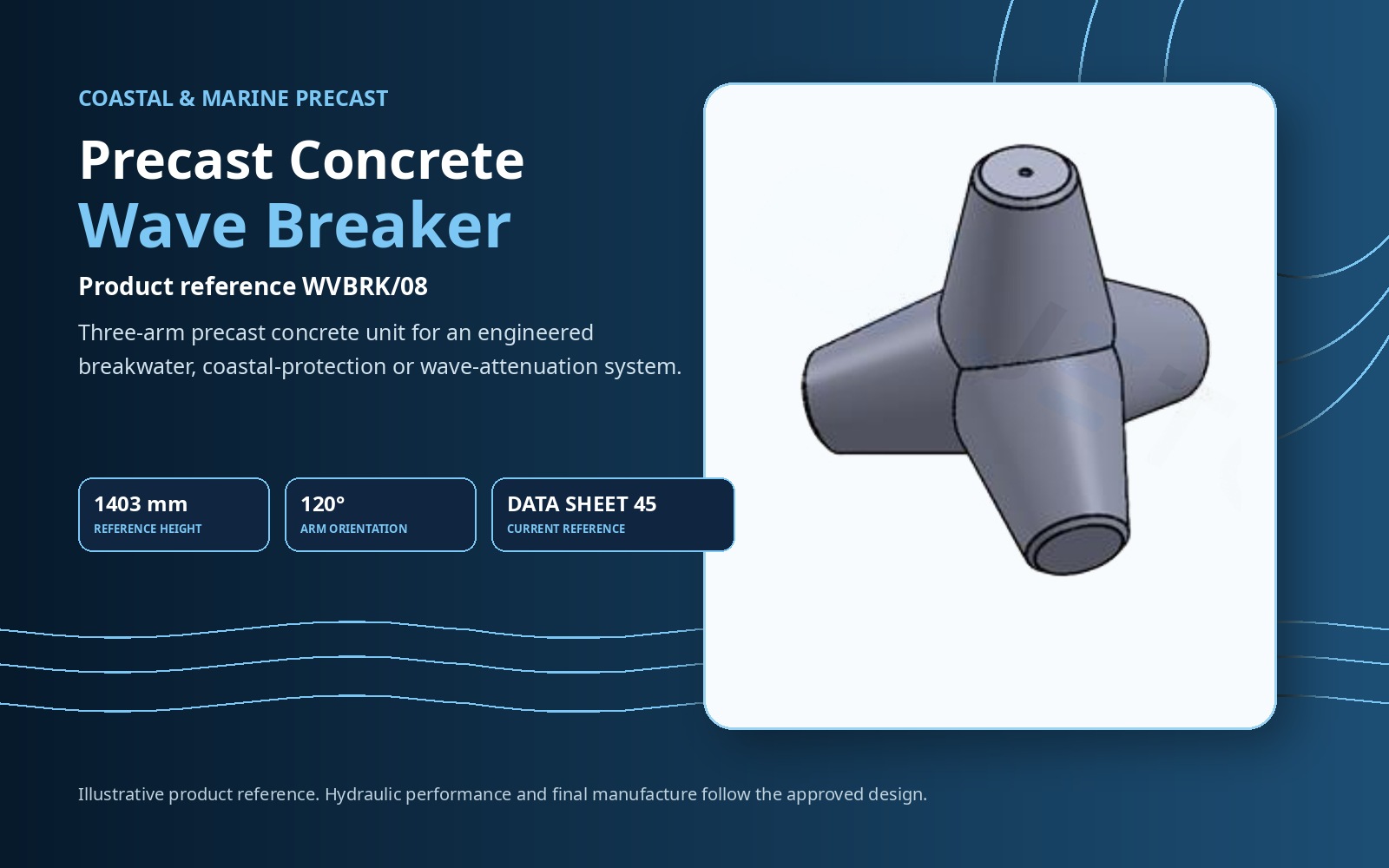
Current Product Reference
WVBRK/08 on Jetons Data Sheet 45.
Engineered-System Use
Selected through hydraulic, structural and geotechnical design.
Marine Durability Review
Concrete, reinforcement, exposure and design life follow the project specification.
Delivery & Placement
Heavy transport, crane or marine-plant support can be coordinated when included.
WAVE BREAKER EXPLAINED
What Is a Precast Concrete Wave Breaker?
A precast concrete wave breaker is a factory-manufactured unit used as part of an engineered coastal-protection arrangement. Depending on the approved design, units may form an armour layer or another protective layer intended to reduce direct wave action, dissipate energy, protect underlying materials and improve the stability of a breakwater, revetment or shoreline system.
Performance does not come from the product name alone. It depends on the unit geometry and mass, design wave conditions, water depth, bathymetry, seabed or foundation condition, layer composition, placement pattern, orientation, density, toe detail and construction tolerances.
Which wave-breaker product does Jetons supply?
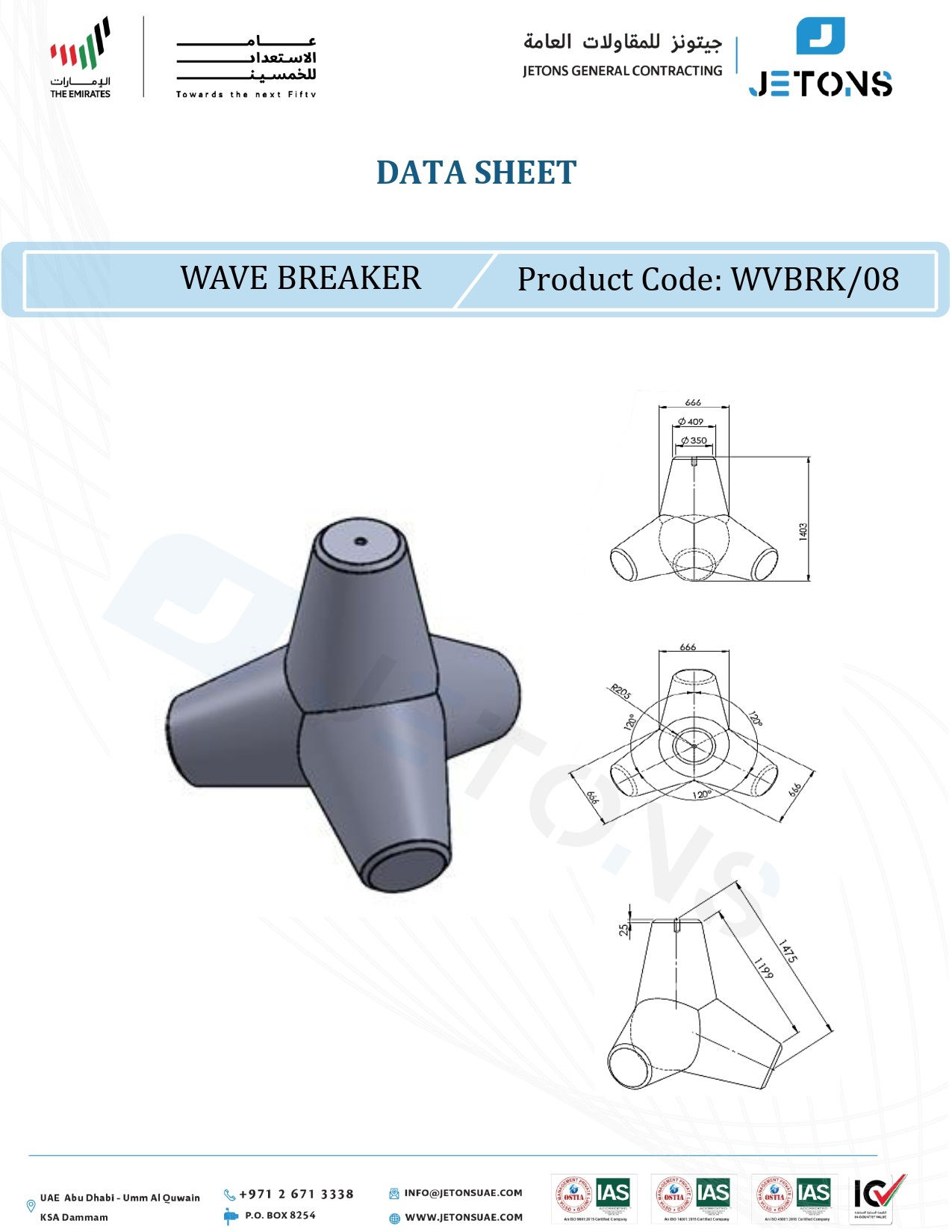
Jetons currently displays Wave Breaker WVBRK/08 on Data Sheet 45. The reference drawing shows a three-arm unit with arms arranged at 120°. The website image is a product reference; the controlled hydraulic and structural design must confirm final unit mass, material specification, lifting and placement requirements.
Wave-Breaker Unit
The individual precast concrete component identified by its controlled geometry, mass, materials, lifting arrangement and placement orientation.
Breakwater Structure
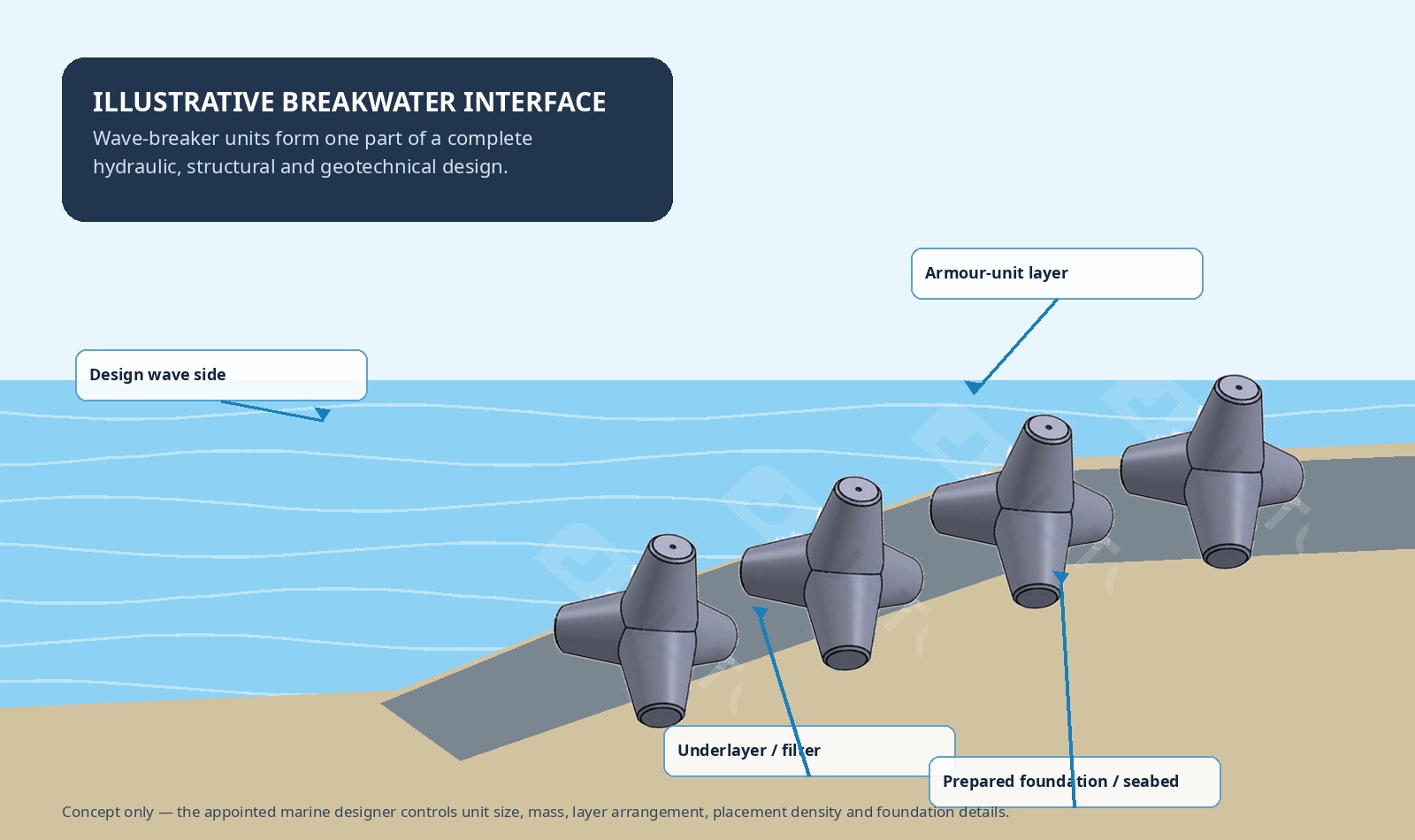
The complete coastal system, which may include a core, filter layers, underlayer, armour units, toe protection, crest details and prepared foundation.
Concrete Armour Unit
A general industry term for shaped concrete units used in a protection layer. Different geometries and proprietary systems are not automatically interchangeable.
SEARCHABLE TECHNICAL REFERENCE
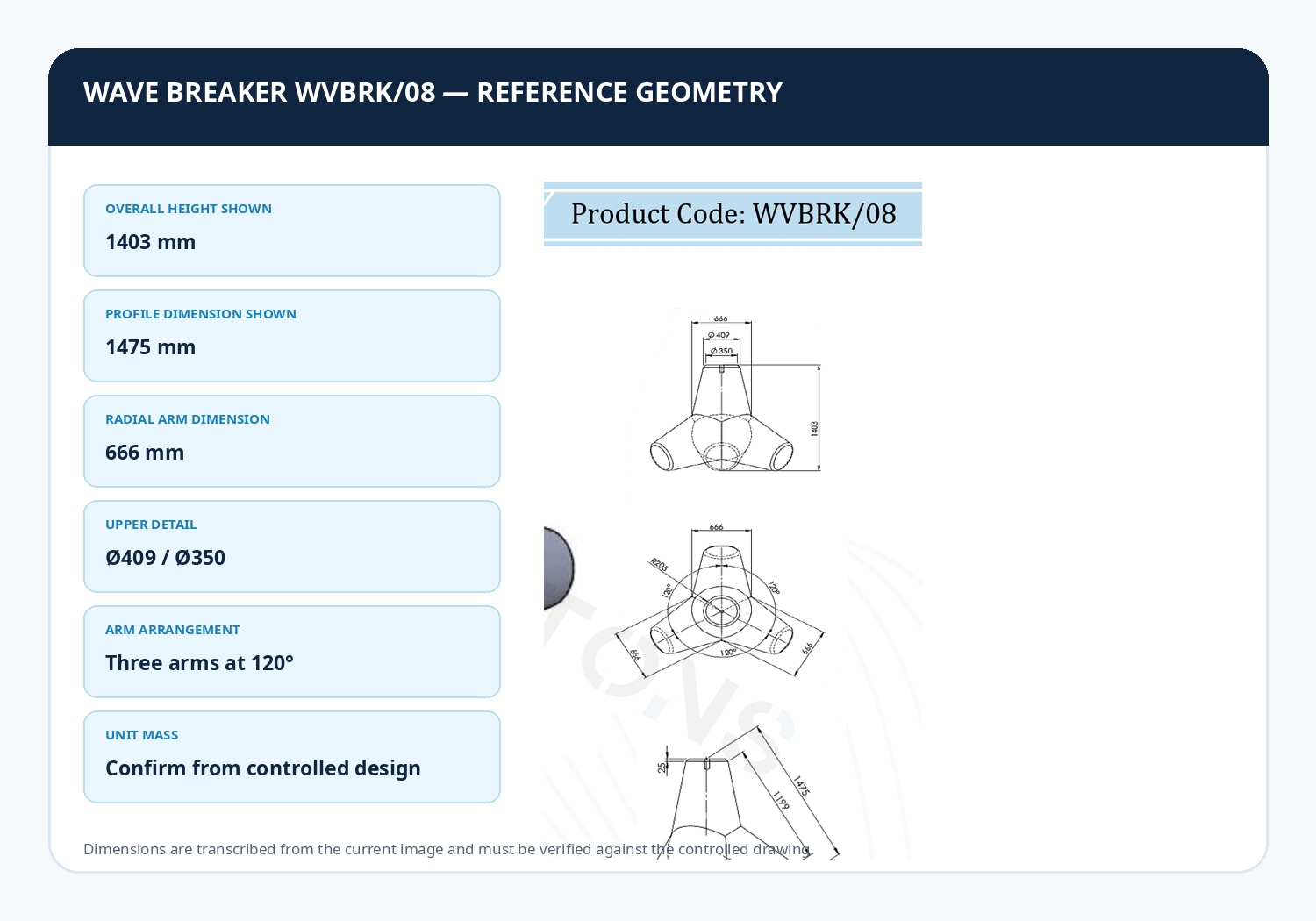
Wave Breaker WVBRK/08 Dimensions & Buyer Checks
The values below are transcribed from the current Data Sheet 45 image so that essential information is available as readable text. The latest controlled drawing remains the governing technical document.
POSSIBLE PROJECT ENVIRONMENTS
Where Precast Wave-Breaker Units May Be Used
The following applications describe common enquiry contexts. Final suitability depends on the approved marine, hydraulic, structural and geotechnical design.
Breakwater Armour Layers
For approved outer or protective layers where the design specifies shaped concrete units, placement density and orientation.
Harbours & Marina Entrances
For engineered protection around harbour basins, marina approaches and navigational entrances subject to wave studies and authority requirements.
Ports & Marine Terminals
For coastal-protection works serving port, terminal, jetty or marine-infrastructure developments when specified by the designer.
Shoreline & Revetment Works
For approved shoreline, revetment or erosion-control arrangements with defined foundation, filter and toe details.
Waterfront Developments
For waterfront communities, islands and coastal developments requiring an engineered wave-control or protection system.
Custom Coastal Structures
For drawing-based hydraulic or marine requirements where WVBRK/08 or a custom mould is technically reviewed against project criteria.
ENGINEERING SELECTION GUIDE
How a Wave-Breaker Unit Is Selected
The correct unit cannot be chosen from a product photo or general name. The appointed marine designer must establish the design basis and demonstrate the stability and performance of the complete system.
- Hydraulic conditions: design wave height and period, water level, currents, overtopping criteria and required wave attenuation.
- Site geometry: bathymetry, seabed levels, slope, crest elevation, toe arrangement and adjacent structures.
- Unit stability: geometry, concrete density, required unit mass, placement density, orientation, interlocking and allowable movement.
- Layer system: armour layer, underlayer, graded rock, filter or geotextile, core and transition details.
- Construction method: land-based crane or marine plant, reach, lifting points, placement tolerances, survey and sequence.
- Inspection and acceptance: trial placement, unit records, damage criteria, as-built survey and consultant approval.
DESIGN INFORMATION
What Must Be Confirmed Before Manufacture
Early coordination reduces mould changes, lifting conflicts, transport issues and rejected placement. The approved design should clearly connect the unit drawing to the complete coastal system.
| Information | Why it matters | What to submit |
|---|---|---|
| Wave and water-level data | Controls required performance, overtopping and unit stability. | Approved hydraulic report, design wave conditions and return period. |
| Bathymetry and seabed | Controls water depth, slope, toe level, founding condition and marine access. | Survey, geotechnical information and approved profile. |
| Unit geometry and mass | Controls stability, interlocking, mould, transport and lifting. | Controlled unit drawing, mass, centre of gravity and tolerances. |
| Layer arrangement | Controls support, filtration, settlement and placement pattern. | Sections showing core, filters, underlayers, armour and toe protection. |
| Concrete durability | Controls service life in splash, tidal, submerged and abrasion zones. | Concrete specification, cover, reinforcement, crack control and testing. |
| Construction method | Controls lifting anchors, equipment, sequence, temporary stability and survey. | Method statement, crane or barge data, access and placement plan. |
Do Not Assume Hydraulic Performance
A unit’s shape alone does not prove suitability for a wave climate, water depth or breakwater slope. Stability and overtopping performance must be demonstrated for the complete arrangement.
Do Not Assume Proprietary Equivalence
Different concrete armour-unit systems use distinct geometries, licences, design methods and placement rules. A similar appearance does not establish equivalence.
Do Not Assume Installation Scope
Production, heavy transport, offloading, marine lifting, underwater placement, survey and acceptance must be clearly allocated in the quotation and method statement.
MARINE DURABILITY
Concrete, Reinforcement and Service-Life Requirements
Marine precast units may be exposed to chlorides, wetting and drying, splash, tidal action, abrasion, impact and handling damage. The project specification must define the durability strategy for the intended exposure zone and design life.
Concrete Specification
Confirm strength class, cementitious system, maximum water-cement ratio, permeability limits, aggregate requirements, curing and temperature control.
Reinforcement & Cover
Confirm reinforcement grade, bar arrangement, minimum cover, crack-control criteria, spacers and any corrosion-protection requirements.
Lifting & Handling
Confirm lifting-anchor design, edge distances, lifting angles, unit mass, centre of gravity, transport restraints and permitted handling stages.
Inspection & Records
Confirm material approvals, mould checks, dimensional tolerances, concrete tests, curing records, repairs, identification and release documentation.
UAE PROJECT COVERAGE
Wave-Breaker Manufacture, Delivery and Placement Support Across the UAE
Marine logistics depend on far more than road distance. Unit mass, route restrictions, port security, delivery windows, crane or barge capacity, tide and weather constraints, laydown space, ground-bearing conditions and placement sequence must be reviewed before dispatch.
Abu Dhabi & Al Dhafra
Support can be planned for Abu Dhabi city, industrial and port areas, island developments, Al Dhafra and remote coastal sites. Early review of permits, access, barge interfaces and delivery windows is essential.
Dubai, Sharjah, Ajman & Umm Al Quwain
Urban waterfront and northern-coast projects may require timed deliveries, traffic planning, port or marina approvals, constrained lifting positions and phased placement.
Ras Al Khaimah & Fujairah
Mountain, industrial, port and open-coast locations may require route surveys, marine-weather planning, specialist lifting equipment, prepared laydown areas and close sequencing with site works.
LOGISTICS & PLACEMENT
Plan the Unit Journey Before Production
Large or heavy marine units should be coordinated from mould to final placement. Changes to lifting points, orientation, transport supports or access after casting can cause delay and risk.
- Confirm unit weight and centre of gravity
- Select lifting anchors and approved rigging
- Review trailer, route and permit requirements
- Confirm port, gate-pass and security procedures
- Check crane, Hiab or marine-plant capacity and reach
- Prepare laydown, access and ground-bearing areas
- Coordinate survey, placement tolerance and acceptance
FROM DRAWING TO PLACEMENT
Wave-Breaker Project Support
Clients may request precast supply only or coordinate a wider scope after technical information, programme and responsibilities are confirmed.
TECHNICAL REVIEW
Drawings & Interfaces
Review the approved unit geometry, hydraulic design basis, reinforcement, concrete, lifting, quantities and missing information.
MANUFACTURING
Mould, Casting & Quality
Plan moulds, reinforcement, concrete, lifting inserts, identification, inspection, curing and production sequence.
TRANSPORT
Heavy Delivery Planning
Coordinate unit mass, trailers, route, permits, delivery windows, access, laydown and dispatch sequence.
PLACEMENT
Lifting & Site Support
Coordinate offloading, crane or marine plant, rigging, survey, placement orientation and handover when included.
QUOTATION CHECKLIST
Information Needed for a Wave-Breaker Quotation
Submit the latest controlled documents and clearly identify which services are required.
- Project name and UAE coastal location
- Approved hydraulic and structural design basis
- Unit drawing, code, revision and approval status
- Required unit dimensions, mass and quantity
- Concrete, reinforcement and durability specification
- Lifting-anchor and centre-of-gravity information
- Layer arrangement, orientation and placement density
- Foundation, underlayer, filter and toe details
- Inspection, testing and documentation requirements
- Production and delivery programme
- Road, port, gate-pass and marine access conditions
- Offloading, crane, barge and placement scope
What Affects Wave-Breaker Price?
There is no reliable universal price per unit without approved technical and logistical information.
- Unit geometry, concrete volume and required mass
- Reinforcement and marine concrete specification
- Mould design, tooling and repetition quantity
- Lifting anchors, identification and special inserts
- Testing, inspection and submission requirements
- Production rate and project programme
- Transport distance, trailer and permit requirements
- Crane, Hiab, barge or marine-plant requirements
- Placement sequence, survey and site supervision
WAVE BREAKER FAQ
Frequently Asked Questions
These answers provide general buyer guidance. Final manufacture and use must follow approved hydraulic, structural, geotechnical and installation information.
What is a precast concrete wave breaker?
A precast concrete wave breaker is a factory-manufactured concrete unit placed as part of an engineered breakwater, shoreline-protection or wave-attenuation arrangement. Its performance depends on the complete hydraulic, structural, geotechnical and placement design rather than on one isolated unit.
Is a wave breaker the same as a breakwater?
No. A breakwater is the complete coastal-protection structure, which may include a core, filter layers, underlayer, armour units, toe protection and prepared foundation. The wave-breaker unit is only one component within that designed system.
Is Jetons WVBRK/08 a Tetrapod, Dolos or Accropode unit?
The current Jetons reference should be identified by its own product code WVBRK/08 and controlled drawing. It should not be described as a Tetrapod, Dolos, Accropode, Core-Loc or another proprietary armour-unit type unless the approved project design explicitly makes that identification.
What dimensions are shown for WVBRK/08?
The current reference image shows an overall height of 1403 mm, three radial arms arranged at 120 degrees, a repeated 666 mm arm reference, an upper detail of Ø409 and Ø350, and a 1475 mm profile dimension. Obtain the controlled drawing before manufacture because the web image does not replace the approved technical document.
What is the unit weight of the wave breaker?
The current web data sheet does not state a verified unit weight. Unit mass and centre of gravity must be confirmed from the approved design because they affect hydraulic stability, transport, crane selection, lifting anchors, placement and temporary stability.
Can Jetons manufacture a custom wave-breaker size?
Jetons can review project-specific geometry, concrete, reinforcement, mould, lifting and quantity requirements against approved hydraulic and structural drawings. Custom manufacture remains subject to technical feasibility, mould cost, production programme and consultant acceptance.
Where can precast wave-breaker units be used?
They may be reviewed for engineered breakwaters, harbour and marina protection, port infrastructure, shoreline or revetment works, waterfront developments and other coastal-protection systems when the appointed marine designer specifies the unit and arrangement.
What information is required before ordering?
Provide the hydraulic design basis, approved unit drawing, required mass and dimensions, layer arrangement, placement density, foundation or seabed details, concrete and durability specification, lifting design, quantity, project location, access conditions and placement programme.
Does Jetons provide delivery and placement support across the UAE?
Jetons can coordinate heavy transport, offloading, crane or marine-plant lifting and placement support when included in the confirmed scope. Route surveys, permits, port access, gate passes, laydown space, crane reach, barge access, tide or weather restrictions and placement sequencing must be reviewed.
What affects the price of a precast wave breaker?
Pricing can depend on unit geometry and concrete volume, reinforcement, marine durability requirements, mould and tooling, quantity, lifting anchors, testing, documentation, transport distance, unit mass, crane or barge requirements and the agreed placement scope.
RELATED PRODUCT ROUTES
Continue Your Marine Precast Review
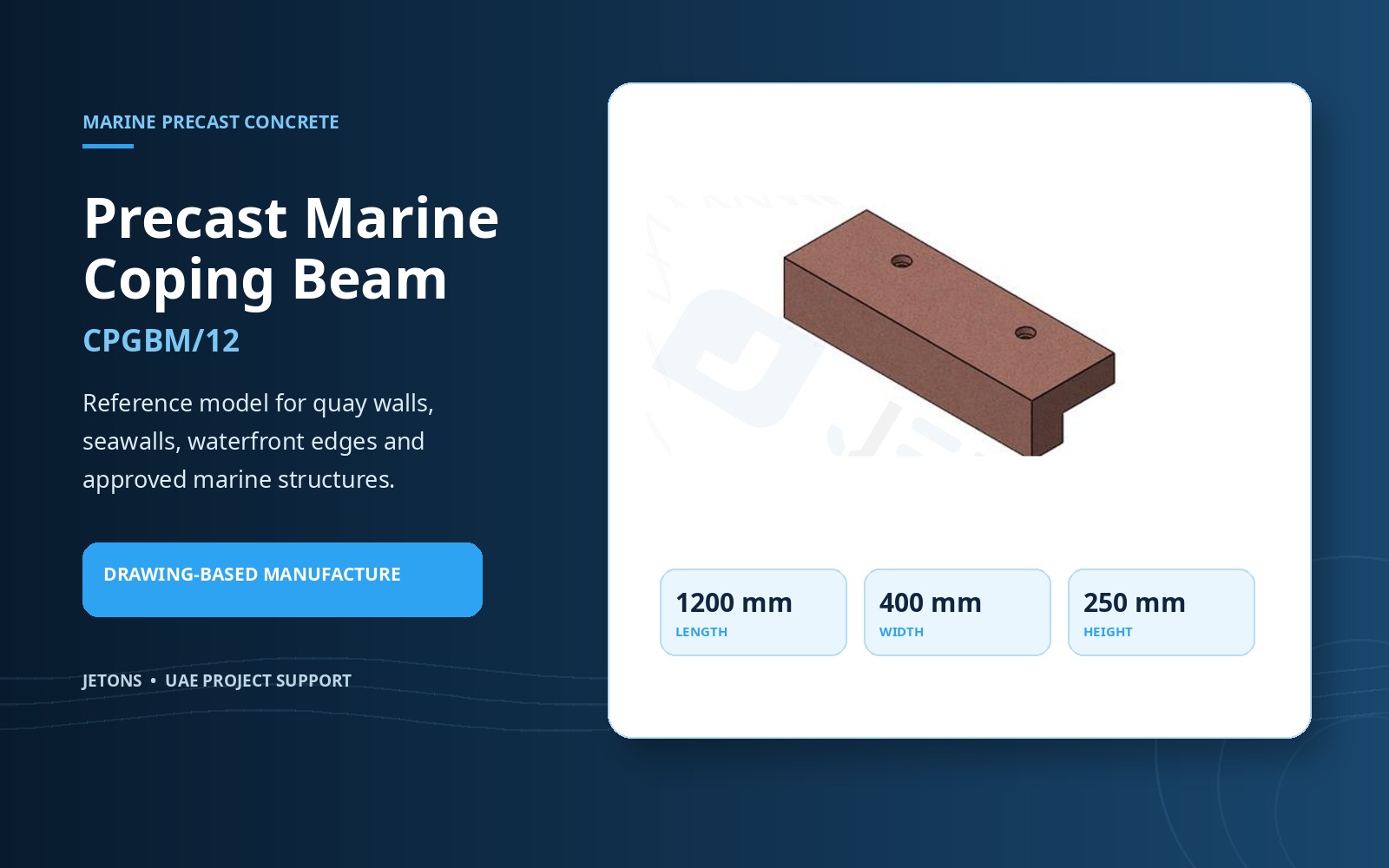
Use the approved project function—not visual similarity—to choose the correct marine or custom precast route.
START THE TECHNICAL REVIEW
Need Precast Wave-Breaker Units for a UAE Coastal Project?
Send the approved hydraulic and structural information, unit drawing, quantity, project location, programme and required delivery or placement scope. Jetons will review manufacturing feasibility and identify the information still needed for a reliable quotation.

DIVISIONS
Jetons General Contracting
Jetons General Trading
Beam Concrete Works
Jetons Transportation
QUICK LINKS
About Us
Projects
FAQ's
Careers
CONTACT US
📞 Phone
📮 P.O. Box
UAE Coverage
Abu Dhabi | Dubai | Sharjah | Ajman | RAK | Al Ain
Supply • Transportation • Installation • Traffic Management
Project Support Across UAE
CERTIFIED & TRUSTED
Certified to International Standards • Trusted by Clients • Committed to Quality
